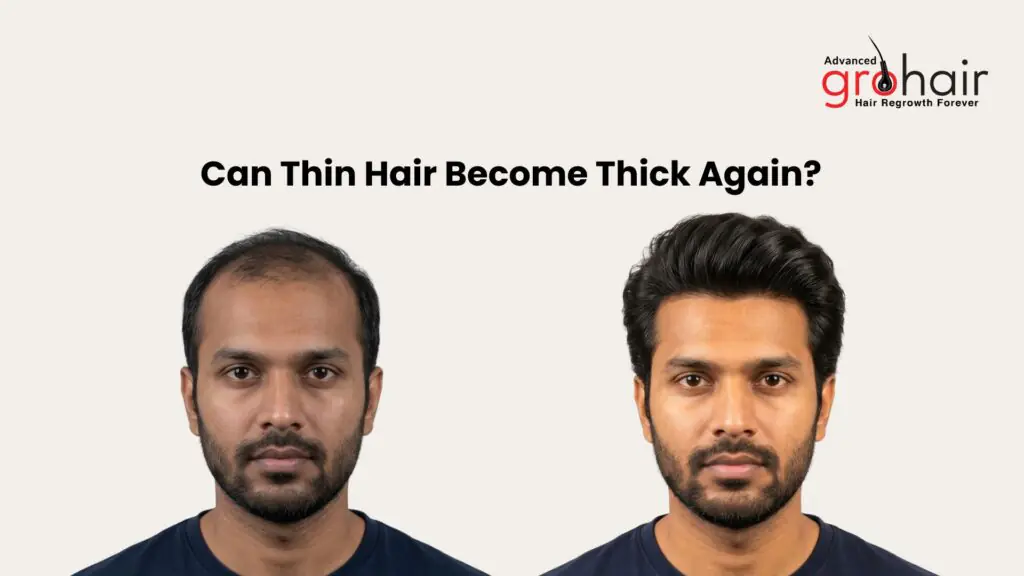
Can Thin Hair Become Thick Again?
It can be stressful to wake up with strands on your pillow or start to see your hairline thinning. To most individuals, hair thinning not only changes appearance but also affects confidence.
Whether you have a progressive loss of hair or a sudden loss of hair, the biggest question is: Can thin hair be thickened again?
The solution lies in understanding the cause and choosing the correct hair loss treatment.
This guide will dissect the science of hair loss, describe how to increase hair density, and explore the ways of regrowth and enhancing overall hair health.
Can Thin Hair Become Thick Again?
The simple answer to this question is yes, thin hair can be made thick, but it will probably only be successful depending on the cause of your hair loss condition.
If your hair loss is temporary, caused by stress, illness, or nutritional gaps, normal hair growth can resume once the trigger is addressed.
Conditions such as telogen effluvium may lead to a higher rate of hair shedding, which usually recovers after some time.
But when the problem is genetic, like androgenetic alopecia, then the case is different. This is a prevalent form of hair loss, in which the hair follicle becomes smaller with time, resulting in lighter, coarser hair and decreased density.
In these situations, specific treatments are needed to trigger hair growth and undo the process.
To restore the thickness of the hair, you have to stimulate growth in follicles that are still viable.
Fine Hair vs. Thinning Hair: Understanding Hair Density
Not all thin hair is the same. It is important to know whether you have thin strands of hair or if you are, in fact, losing hair.
Fine hair is defined as the diameter of each strand. When your hair is thin in nature, it cannot become thick physically.
Thinning hair, on the other hand, is a decrease in the density of hair on the scalp, usually as a result of loss of hair.
The aim is not to alter the size of the strands but to enhance the number of hairs and volume.
Thickening your hair in general and attaining healthier hair by getting to the root of your hair is possible.
The Root Causes: Why Is Your Hair Thinning?
Before initiating any viable treatment, it is important to understand the cause of the problems with hair.
1. Pattern Hair Loss and Genetics
Androgenetic alopecia causes conditions such as pattern hair loss, male pattern hair loss, and female pattern hair loss. This causes hair thinning that is gradual, and ultimately, baldness is observed.
2. Stress and Telogen Effluvium.
When the stress level is high, the hair may enter a resting period, leading to excessive shedding. This disease is referred to as telogen effluvium, which is a temporary type of hair loss that can be regained once the cause of stress is eliminated.
3. Nutritional Deficiencies
Deficiency of the necessary vitamins and minerals may also make the strands weak and lead to hair thinning. Malnutrition directly impacts hair condition, and it can cause hair loss.
4. Hormonal Changes
Hormonal imbalances, particularly in female hair loss, may interfere with the hair growth cycle, resulting in massive hair loss.
5. Autoimmune Conditions
In some isolated instances, the immune system assaults the hair follicles, and the resultant conditions are sudden loss of hair, such as alopecia.
Proven Treatments for Hair Loss to Thicken Your Scalp
1. Topical Treatments
One of the best topical solutions is Minoxidil. It aids in stimulating the hair follicle, enhancing the blood flow in the scalp and aiding in the growth of hair.
Regular application of minoxidil could prevent hair loss, enhance density, and support the healthy growth of hair.
2. Clinical Treatments
The more advanced ones are platelet-rich plasma therapy, where platelet-rich growth factors are injected into the scalp to promote follicles.
Other advanced hair solutions include low-level laser therapy, which uses light energy to promote hair growth and improve follicle activity.
These hair science breakthroughs offer long-term hair loss solutions.
3. Surgical Options
When follicles stop functioning completely, a hair transplant is the most reliable hair restoration method.
This procedure redistributes healthy follicles to thinning areas, helping restore hair density and achieve lasting results.
Natural Remedies to Promote Hair Growth and Health
Besides clinical treatment, natural ways can assist hair growth and improve the overall condition.
Key Remedies
- Eat a lot of vitamins and minerals to promote healthy hair.
- Scalp massage to enhance blood supply to the hair.
- Delicate hair care to prevent damage.
These approaches help promote hair growth, strengthen strands, and maintain a healthy environment.
Daily Habits to Make Thin Hair Appear Thicker
While waiting for results, you can improve the appearance of thinning hair with simple changes.
Practical Tips
- Use hair thickening solutions and volumising products
- Do not use tight hairstyles that accentuate the hairline.
- Select layered cuts to make hair look thicker.
These plans can assist you in making your hair appear thicker as you deal with hair growth.
The Hair Growth Cycle: How Long Until Hair Returns?
When addressing hair loss, it is important to understand the hair growth cycle.
Once shedding has ceased, in the instances that are not permanent, hair growth may restart without medical intervention. Hair usually goes back to normal within 3-6 months.
Nevertheless, chronic cases of hair loss might need lifelong therapy. The most important part is patience in an attempt to regrow hair and see some improvements.
When to See a Doctor or Hair Loss Specialist
When you are losing hair at an alarming rate or hair thinning may leave patches in your hair, it is time to see a dermatologist or a hair loss expert.
A professional can:
- Determine what is causing your hair problem.
- Prescribe a customised hair loss remedy.
- Include factors that guide you through effective hair loss.
Early diagnosis assists in treating hair prior to the aggravation of the situation.
Conclusion
So, can thin hair become thick again? Yes, but you have to do it in the right way! The initial step in achieving a successful hair restoration is to understand the underlying cause of your problem, whether it is temporary or genetic.
With the help of the right treatments, the right lifestyle, and regular care, you will be able to grow hair, increase hair density, and have healthier hair in the long run.
When you are having trouble with your hair loss, do not wait. Get professional help, find out what has worked to help people with their hair loss, and take the initial step to recover your hair.
Frequently Asked Questions
Is my hair naturally fine or actually thinning?
Fine hair refers to the thickness of each strand, which is genetic. Thinning hair refers to a decrease in density (fewer hairs per square inch). If you can see more of your scalp than usual, you are likely experiencing thinning.
Can you reactivate "dead" hair follicles?
Follicles that are dormant due to stress or nutrition can be reactivated. However, if a follicle has permanently shrunk or scarred over due to advanced male or female pattern baldness, it cannot grow hair naturally and may require a transplant.
Which nutrient deficiency causes the most hair thinning?
Iron and Vitamin D deficiencies are the most common culprits. Without enough iron, your blood cannot carry sufficient oxygen to your follicles, causing them to enter a resting phase and shed prematurely.
How long does it take to see results from thickening treatments?
It typically takes 3 to 6 months to see visible results. Because hair only grows about half an inch per month, you must wait for the new, thicker strands to emerge from the scalp and grow long enough to notice.
Does cutting hair shorter make it grow back thicker?
No. Cutting your hair only affects the ends, not the follicle where growth happens. Shorter hair may look thicker because you’ve removed thin, damaged ends, but it does not change the actual density of your hair.
Book An Appointment