How to Fix Hair Transplant Scars: Top Repair Treatments
18 Mar, 2026
If you’re looking for how to fix hair transplant scars, you finally went for the procedure to regain your confidence, only to find that visible scars are now a daily reminder of the surgery.
Whether you are dealing with a linear FUT scar, FUE dots, or patchy thinning, these marks don’t have to be permanent.
The harsh reality is that transplant scars can actually deteriorate over time without proper maintenance. Fortunately, from laser resurfacing and SMP camouflage to scar revision surgery, there are proven ways to correct them.
Here is how to finally erase those marks and achieve the seamless, natural look you originally wanted.
Hair Transplant Scarring: Causes and What to Expect
Every surgical hair restoration leaves some level of scarring, but the type and severity depend on several key factors:
Technique (FUT vs. FUE): FUT typically leaves a linear scar, while FUE results in tiny, circular dots.
Surgeon Expertise: Precision and closure techniques are critical for minimizing visible marks.
Biological Factors: Your skin type, genetics, and natural healing ability dictate how tissue repairs itself.
Beyond the clinic, lifestyle choices like sun exposure, improper post-op care, and even tension on the scalp can cause scars to stretch or darken over time. Understanding these variables is the first step in managing your expectations and ensuring a seamless result.
FUT vs. FUE: The Difference in Scarring
| Feature | FUT (Follicular Unit Transplantation) | FUE (Follicular Unit Extraction) |
| Scar Type | Linear scar (a horizontal line). | Tiny circular scars (small dots). |
| The Cause | A strip of skin is removed and sutured. | Individual follicles are extracted via “punches.” |
| Appearance | A permanent line at the back of the scalp. | Small, spread-out spots across the donor area. |
| Visibility | Noticeable with short hair; can be thin or wide. | Blends better but visible if the scalp is shaved. |
| Worst-Case | Can stretch over time, making the line thick. | Can result in patchy, uneven bald areas. |
Did You Know?
Even though FUE is often advertised as “scarless,” it still leaves marks—they’re just harder to see than FUT scars.
Types of Hair Transplant Scars
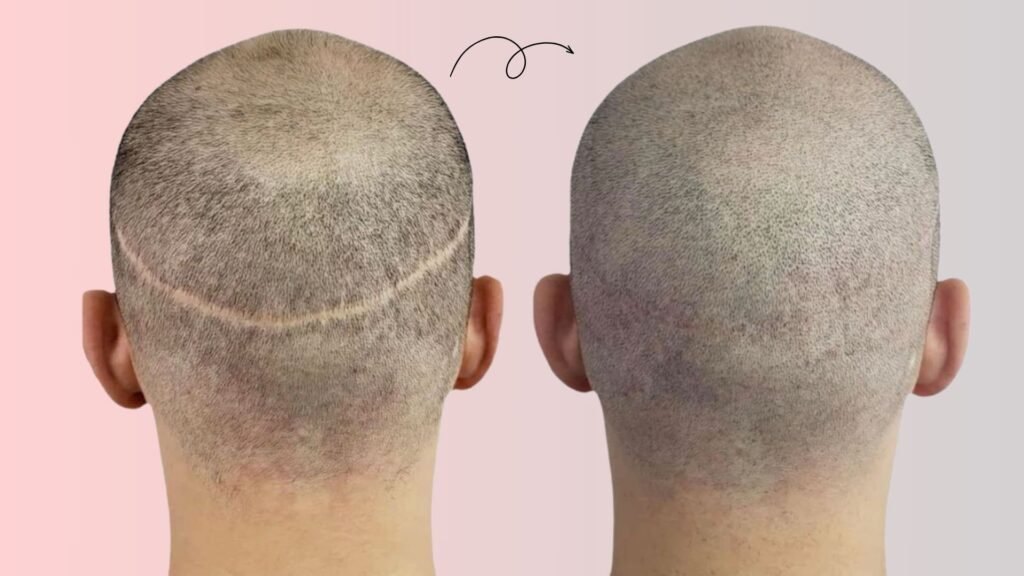
1. FUT Hair Transplant Scars – Linear Scar Formation
✔ Appearance: A single horizontal scar running across the back of the scalp.
✔ Cause: A strip of scalp is removed, and the area is sutured closed.
✔ Worst-Case Scenario: If not stitched properly, the scar can stretch, making it wider over time.
✔ Best Treatment: Scar revision surgery (to minimize width) or SMP (to blend it in).
2. FUE Hair Transplant Scars – Tiny Puncture Mark Scars
✔ Appearance: They leave tiny, dot-like scars throughout the donor area.
✔ Cause: Each follicular unit is extracted individually with a small circumference punch tool.
✔ Worst Case: With an inadequate extraction method, you may end up with uneven and patchy scarring on the donor site.
✔ Best Solution: SMP (Scalp Micropigmentation) or laser treatment to blur it out.
3. Scarring Alopecia – When Hair Loss Causes Permanent Scarring
✔ Issue: Smooth, shiny bald patches where hair will not grow.
✔ Cause: Follicles are irreparably damaged by autoimmune disorders, infections, or inflammatory conditions that affect hair loss.
✔ Worst Case Scenario: Hair cannot grow back in the affected area.
✔ Best Treatment: PRP therapy (for healing stimulation), SMP (for spot camouflage), or FUE transplant (for new hair growth).
The Best Treatments for Hair Transplant Scars
1. Medical & Surgical Scar Treatments
- Scar Revision Surgery – If your FUT scar is wide or raised, a skilled plastic surgeon can remove the old scar and re-stitch it more neatly, making it thinner and less noticeable.
- Hair Transplant Over a Scar – If the scar has no hair, small FUE grafts can be placed into the scar tissue to help it blend into the surrounding hair.
- FUE for Scar Repair – This technique is used to fill in bald patches on scars by carefully implanting new follicles where hair no longer grows.
Pro Tip: If you’re getting an FUE transplant over a scar, make sure your surgeon has experience working with scar tissue—it heals differently than normal skin.
2. Non-Surgical & Cosmetic Scar Treatments
- Scalp Micropigmentation (SMP) – A game-changer for scar camouflage. Tiny pigment dots are tattooed into the scar to mimic real hair follicles. This works well for both FUT and FUE scars.
- Laser Therapy – Some fractional lasers break down the scar tissue and promote collagen production, thus smoothing out and reducing the appearance of scars.
- PRP Therapy – Platelet-rich plasma injections enhance blood supply to scars so that they heal faster and promote new hair growth.
3. Natural Remedies & At-Home Scar Care
- Topical Scar Remedies – Vitamin E cream and silicone gels can make scars soft after a while.
- Scalp Massage & Oils – Coconut oil, rosemary oil, and castor oil are natural home remedies that promote nourishment for scarred hair.
- Microneedling for Scars – Fine needle derma rolling triggers production of collagen and enhances the quality of scars.
Important: These treatments are most effective on small scars. For deeper scars, medical intervention is required.
How to Prevent Hair Transplant Scars from Getting Worse
✔ Follow your surgeon’s post-op care strictly (especially for FUT closures).
✔ Avoid stretching the scar by keeping your scalp moisturised and avoiding excessive tension.
✔ Protect your scalp from the sun—UV rays make scars more visible and harder to treat.
✔ Consider PRP therapy early—it boosts healing and may prevent noticeable scarring.
Choose the Right Hair Transplant Clinic for Scar Repair
✔ Look for clinics specialising in scar repair—not just general hair transplants.
✔ Request actual before-and-after pictures to observe their work on scars.
✔ Be realistic in expectations—not all treatments will result in 100% invisible scars, but they can be life-changing.
Conclusion
While hair transplant scars can be frustrating, they don’t have to be permanent. Whether your scars are thin, broad, or patchy, effective treatments exist to correct them, ranging from scar revision and Scalp Micropigmentation (SMP) for FUT scars to laser therapy for FUE marks. If you are dealing with completely bald scar tissue, an FUE transplant directly over the scar can even regrow hair in that area.
Ultimately, the right choice depends on your specific goals—whether you want to conceal the scar instantly with SMP, reduce its physical size through revision surgery, or restore natural hair growth. Your scars shouldn’t define your hairline, and by consulting a specialist to research the best treatment for your scar type, you can choose a clinic that understands your unique case. Confidence shouldn’t come with conditions, and taking control of your repair options is the first step toward a seamless result.
Book An Appointment
Also Read