Mesotherapy vs. PRP– Which Non-Surgical Treatment Is Better for Hair Loss?
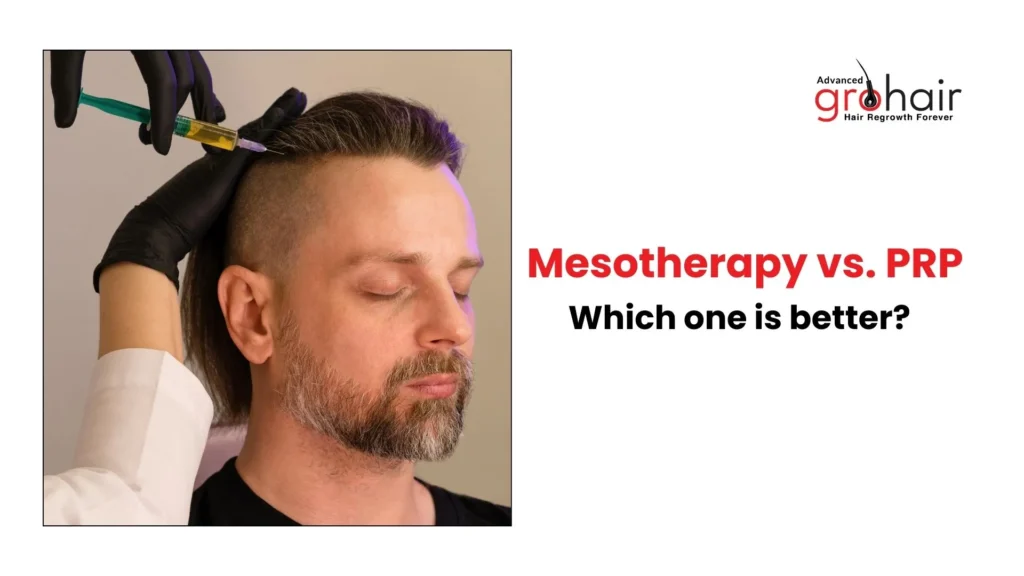
If you’re comparing mesotherapy vs PRP, you’re already doing the smart thing: looking for non-surgical options before jumping to bigger interventions. Both mesotherapy and PRP have earned a place in modern hair loss treatment because they target the scalp, support healthier hair follicles, and may help stimulate natural recovery in the early stages of hair loss.
But they are not identical twins wearing different lab coats. The science, the materials, the injection approach, and the ideal patient profile vary. This guide breaks down mesotherapy vs PRP in practical terms, so you can discuss the treatment options confidently with a dermatologist and choose the treatment that is right for your specific hair needs.
Hair Loss and Why the Scalp Needs Help
Hair loss isn’t a single-condition problem. It’s a pattern of biological events happening at the scalp level, often involving inflammation, hormonal signals, nutritional gaps, local circulation changes, or genetic sensitivity.
Common Causes of Hair Loss and Hair Thinning
A lot of people start noticing hair thinning before visible bald patches appear. This is common in androgenetic alopecia, a major contributor to pattern baldness in both men and women.
Other triggers include stress, postpartum changes, thyroid issues, and deficiencies. In many cases, hair loss due to multiple factors creates a confusing hair loss pattern that needs expert evaluation.
What Happens to Hair Follicles During Hair Loss
During progressive hair loss, the hair follicles miniaturise. Some become dormant hair follicles, meaning they’re not dead, but they’re not working at full capacity either. This is why early intervention matters.
The way hair loss works biologically is gradual; you often still have existing hair that can be protected or strengthened if the right plan is started at the right time.
What is PRP Therapy for Hair Loss?
PRP stands for platelet-rich plasma. It’s a regenerative treatment that uses concentrated components of your own blood to support tissue recovery. In hair applications, PRP therapy is designed to awaken or strengthen compromised follicles and improve overall scalp function.
How PRP Hair Treatment Works
A small amount of your blood is drawn, processed to concentrate platelet content, and prepared for scalp use. Because it uses your own blood, PRP is generally viewed as biologically compatible. The prepared solution is rich in growth factors and sometimes described as rich in growth signals that can support cell repair.
Your clinician then performs PRP injections that are injected into the scalp across targeted injection sites. This matters because consistent placement can influence outcomes.
Platelet-Rich Plasma and Growth Factors
The key value of platelet-rich plasma is the presence of growth factor activity. Research suggests these signals may help with regeneration, support healthier follicle environments, and potentially stimulate hair growth. In practical clinical language, PRP stimulates the scalp’s repair pathway rather than forcing hair to grow overnight.
PRP Uses for Hair and Skin Rejuvenation
While PRP treatment is one of the most popular indications, PRP uses extend beyond hair. PRP is widely discussed for wound support, sports medicine, and skin rejuvenation. The same regenerative logic applies: boost local repair signals and support production of new collagen in skin contexts. That said, your provider will focus on hair-specific protocols when using PRP for treating hair loss.
What Is Mesotherapy for Hair Loss?
Mesotherapy is a technique that introduces carefully selected nutrients or medications into the scalp environment. It’s a targeted scalp-support strategy that’s also popular in aesthetic medicine.
How Mesotherapy Involves Injecting Nutrients into the Scalp
In simple terms, mesotherapy involves small, controlled doses delivered across the scalp using multiple micro injection points. The method is often described as involving injecting supportive compounds into the skin layers.
Traditionally, the concept references the middle layer of skin. In some explanations, mesotherapy is described as being injected into the mesoderm, a phrase that is often used to communicate the technique to the public, though what matters clinically is the intended layer of the skin and how the formulation is delivered and absorbed. In practice, the mixture is administered into the scalp at selected injection sites.
What Is Used in Mesotherapy?
This is where formulation matters. A cocktail used in mesotherapy can include vitamins, amino acids, minerals, or other medically approved components based on your diagnosis. What is used in mesotherapy varies by clinic and patient profile. The goal is usually to nourish the scalp, improve microcirculation and blood circulation, and help stabilise early miniaturisation patterns.
Some clinicians explain that it may improve blood flow locally, which can indirectly support follicle health and improve hair quality over time.
Mesotherapy for Hair Loss and Skin Rejuvenation
Mesotherapy for hair loss is commonly positioned as a supportive plan, especially for mild-to-moderate diffuse shedding. It’s also used in aesthetics for skin rejuvenation and broader rejuvenation goals.
Patients often ask how mesotherapy differs from PRP. The simplest difference is that mesotherapy primarily supplies external nutrients or compounds, while PRP supplies your internal regenerative signals.
Mesotherapy vs. PRP for Hair Loss – Key Differences
This is the core question: PRP vs. mesotherapy, what’s the real-world difference?
Mechanism – How Each Treatment Stimulates Hair Growth
PRP relies on your own platelet concentration and is rich in growth factors that may encourage cellular repair. The clinical logic is that PRP may stimulate recovery pathways and stimulate hair cycles in weakened follicles.
Mesotherapy, by contrast, provides an external support blend designed to nourish and optimise local conditions. That difference is why many clinics discuss PRP and mesotherapy as complementary rather than always competing.
Treatment Process – Involves Injecting into the Scalp
Both treatments involve an injection approach and are non-surgical.PRP is a bio-based approach derived from a small amount of your blood. Mesotherapy uses a customised topical-injectable blend.
If you’re reading clinic pages, you may see phrasing like PRP therapy and mesotherapy presented together. Some practitioners also call out therapy and mesotherapy combinations in standardised protocols.
Effectiveness – Which Treatment Is Better for Different Hair Loss Patterns?
This is where nuance beats hype.
- PRP is frequently recommended for androgenetic alopecia and genetically driven pattern baldness, where the goal is to strengthen thinning follicles and preserve existing hair.
- Mesotherapy may be suggested for early diffuse thinning, stress-related changes, or cases where scalp nutrition and microenvironment need support.
Some patients report better results with PRP, others with mesotherapy. The truth is that outcomes depend on diagnosis, consistency, and realistic expectations. That’s why the best clinics position themselves both as effective treatments for hair loss, not miracle shortcuts.
Safety, Side Effects, and Recovery –PRP vs. Mesotherapy
Risk of Side Effects and Allergic Reactions
| Category | PRP (Platelet-Rich Plasma) | Mesotherapy |
| Safety Profile | Generally considered very safe because it utilizes the patient’s own blood. | Generally safe, but introduces external compounds into the body. |
| Common Side Effects | Temporary soreness, swelling, or mild bruising at the injection sites. | Similar to PRP, including localized swelling and bruising at injection sites. |
| Allergic Reaction Risk | Minimal to none; since the substance is autologous, there is little risk of rejection. | Higher risk; clinicians must carefully assess allergy history before treatment. |
Comfort Level, Downtime, and Injection Frequency
Both PRP and mesotherapy are typically outpatient procedures. The number of sessions varies. Your doctor may adjust the schedule based on whether you’re experiencing hair shedding actively or stabilising a longer pattern.
Mesotherapy vs PRP: Which Treatment Is Right for You?
Choosing between these two isn’t a personality quiz. A qualified hair Specialist will determine the best approach based on your:
- Diagnosis
- Stage of hair loss
- Scalp condition
- Lab results (if needed)
- Lifestyle and consistency capacity
When PRP Is a Better Option
You may lean toward PRP if:
- Your hair loss due to genetics is becoming noticeable
- You want a regenerative strategy tied to growth factor activity
- You’re exploring advanced hair restoration support protocols
- You want to preserve existing hair while encouraging stronger density
Many clinics note that PRP support visible improvement in texture and density when done consistently and combined with supportive care.
When Mesotherapy May Be More Suitable
You might consider mesotherapy if:
- You are in the early stages of hair loss
- The goal is to combat hair loss by improving scalp nutrition
- You need a targeted strategy to promote hair growth and stabilise diffuse thinning
In some combined plans, clinicians may use mesotherapy and PRP in a phased or alternate schedule.
Conclusion
PRP is a treatment that uses your own regenerative biology, platelet-rich plasma that is rich in growth factors, delivered through carefully planned injection points into the scalp. Mesotherapy focuses on external support: a targeted cocktail that may improve scalp nutrition, blood circulation, and the environment needed to protect existing hair and potentially stimulate hair growth.
If you’re still unsure which treatment is better, that’s normal. The most reliable path is a clinical evaluation with a Hair Specialist who can map your hair loss concerns, identify your hair loss pattern, and determine the best plan for your specific hair profile, whether that’s PRP, mesotherapy, or a smart blend of both.
FAQs
Which is better: PRP vs. mesotherapy for hair loss?
The honest answer is “it depends.”PRP vs. mesotherapy comparisons should be tailored to your diagnosis. For genetic pattern baldness, PRP may be a stronger, better option. For diffuse nutrition-related concerns, mesotherapy may be a reasonable starting point.
Can PRP and mesotherapy be combined?
Yes. Many dermatology practices use PRP and mesotherapy in structured plans. You might also see phrase variants like mesotherapy and PRP in clinic protocols.
Do these treatments create new hair?
Some patients report new hair growth over time, and in select scenarios, clinicians may observe promoted new hair growth trends. But outcomes vary, and you should expect gradual change rather than instant density jumps.
Is mesotherapy safe if I’m worried about allergies?
Discuss your history of allergic reactions. Your doctor will evaluate the risk of allergic reactions based on what is being used in the formulation.
Book An Appointment